Reading Water on a Rainy-Day Facade Walk
A rainy-day facade walk helps you trace visible water paths across brick, stone and ledges, so you can notice how a building’s details shape the view.
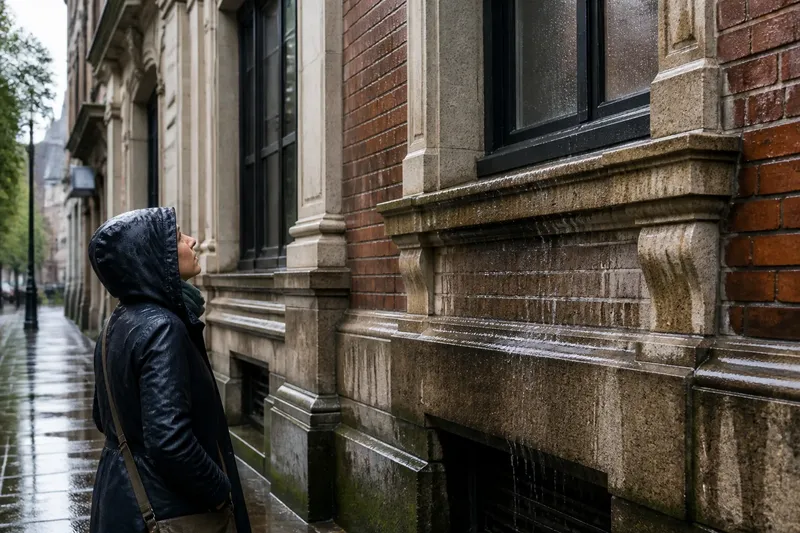
The most common mistake on a rainy-day facade walk is to spot a dark patch and call it a leak. That shortcut costs you the more revealing details: a water line split by a ledge, a glint that stops at a joint, or a sheltered strip beneath a sill. Treat what you see as a temporary pattern, not a diagnosis.
Choose a public route where you can stop without blocking a doorway or standing in a puddle. Watch one facade at a time, from a safe distance. Stains, leaks and structural concerns need assessment by a qualified professional; a pavement-side view cannot establish their cause.
Let the rain show the building’s shape
At the first drops, a wall may show little more than scattered dark flecks. As rain reaches projecting edges, recessed joints and broad wall faces, differences become easier to see. A light shower and gusty rain can make the same facade appear different, so describe the conditions plainly rather than treating one view as definitive.
Start with the whole building. Notice where it steps in and out around balconies, window surrounds, pilasters or entrance recesses. Raised parts catch light and shade differently from the wall behind them, making the building’s relief easier to read.
Stay on a public pavement or another place where stopping is permitted. Do not lean on gates, enter private courtyards or stand beneath an edge for a closer look. Binoculars are optional; use a phone camera only if doing so leaves the pavement clear and your attention on your surroundings.
Compare how brick, stone, tile and render catch the light
Rain alters a surface’s appearance before it changes the shape of the wall. Smooth glazed tile may carry a continuous glint. Rough brick can become a patchwork of darker and lighter faces, while textured stone may hold small shadows around its grain. Painted render can look even from one angle and reveal subtle variations from another.
Compare neighbouring surfaces instead of assigning a fixed meaning to a colour. Two bricks exposed to the same rain may darken differently because of their texture or angle. A stone band may look paler simply because its face turns towards the light. The useful observation is the contrast, not a confident claim about its cause.
Change your viewing angle and notice where the highlight moves. It is like turning a glazed mug beneath a kitchen light: the object stays put, but its bright reflection slides across the surface.
Trace a visible route without filling in the gaps
Choose a starting point you can see, such as the top of a window surround or the underside of a sill. Follow the water with your eyes. Does its sheen break at a joint? Does a narrow run appear below a projecting edge? Does rough texture spread the wetness into a softer patch?
Then look sideways. A projecting sill, decorative course or change in material may interrupt a route and direct water towards an edge. A groove can make a narrow line visible; a rough face may scatter the sheen. Stop tracing wherever the route disappears from view.
Imagine a made-up shopfront in a steady shower. Its shallow entrance lip gathers water, which separates around a raised stone detail. In this invented situation, suppose you can see two finer runs below the detail and a shifting sheen on the adjacent brick. Those are the observable results to look for; if the runs remain visible, describe their split and direction, but if they disappear behind the stone, record only the visible gathering at the lip. Neither outcome establishes anything about the wall’s condition.
Compare ledges, recesses and projecting details
A deep sill projects farther from the wall than a narrow string course, and a balcony slab or canopy can shelter the surface beneath it. Compare the exposed face above an edge with the strip below, then watch where the two meet. The contrast may be clearer than the detail’s material name.
Recessed windows offer another comparison. Their side reveals and upper soffits sit back from the main wall, so their sheen may differ from the surrounding surface. Notice whether a reveal reads as a dark frame, a bright strip or a changing mix. Keep your attention on the outer geometry, not private interiors.
A metal flashing may show a bright line as rain crosses it; a projecting sill may carry droplets towards its ends. Look for the route visible in that moment. Similar-looking ledges can meet the weather differently because their shapes and finishes differ.
Use joints to read the facade’s pattern
Mortar joints, panel seams and tile boundaries divide a wall into smaller fields. Watch whether the sheen crosses each line evenly or appears to pause, gather or change direction. Brick joints can make a wall read as a grid; repeated cladding seams can break a broad plane into a sequence of panels.
Keep notes exact. “The sheen changes at the horizontal joint” records an observation; “the joint is failing” makes a diagnosis. Rain, shade, surface coatings and viewing angle can all affect what appears from the pavement.
Look for repetition across nearby bays. If similar joints are visible in several places, compare how their wet edges line up. That repeated pattern can make the facade’s rhythm easier to see than it is on a dry day.
What can a rainy-day facade walk tell you?
Which surface changes most as it gets wet?
Compare sheen, darkness and visible texture across adjoining materials. Describe the contrast without treating appearance alone as evidence of damage.
Where does a visible water path begin?
Start at an edge or projection and follow the route only as far as you can see it. If it vanishes behind a ledge or into a recess, leave the hidden section uncertain.
What changes where a ledge meets the wall?
Look for a shifted highlight, a narrow run or a sheltered patch beneath the edge. Compare the detail with a similar feature elsewhere on the same facade, if one is visible.
How does the facade meet the pavement?
Notice whether water appears as a broad sheen, separate tracks or small reflective patches near the base. Keep clear of puddles and entrances, and do not infer a hidden source from the ground alone.
Follow the scene down to the pavement
Finish each facade by looking at its base. Does a visible run end at a lower ledge, drainpipe or sheltered entrance? Is the paving glossy, speckled or covered by a thin film? Link a patch on the ground to the wall only if you have watched the route connect.
Keep clear of downpipes and entrances. A pipe may carry water from a roof beyond the part you can see, while a doorway canopy can change the wetness beneath it. Paving joints, kerbs and gentle slopes also shape the way water appears at street level.
On a route with several buildings, compare their bases as well as their upper details. One facade may meet the paving beneath a sheltered strip; another may show separate tracks. These are observations about the street’s visible arrangement, not a condition report.
Keep notes tied to what you actually saw
Before moving on, choose one clear detail to remember: a run split by a stone band, a sheen changing at a brick joint, or a bright line along a metal edge. If you take a photograph or make notes, include the weather and your viewing position. That context helps keep memory from filling in what the rain concealed.
A rainy-day facade walk is most useful when it leaves room for uncertainty. Record the visible route across brick, render, tile or metal, and note where a ledge or recess changes it. If you are concerned about a building’s condition, share your observations with a qualified professional rather than drawing a diagnosis from the pavement.
One practical courtesy makes close looking easier for everyone: step aside before stopping to study a detail. Rain keeps moving, and another clear view may open up along the next stretch of pavement.