The Picture Window and the Changing View
Picture window design frames a changing scene. Learn how glass, sill, frame and setting shape the view, and what to notice as light and seasons shift.
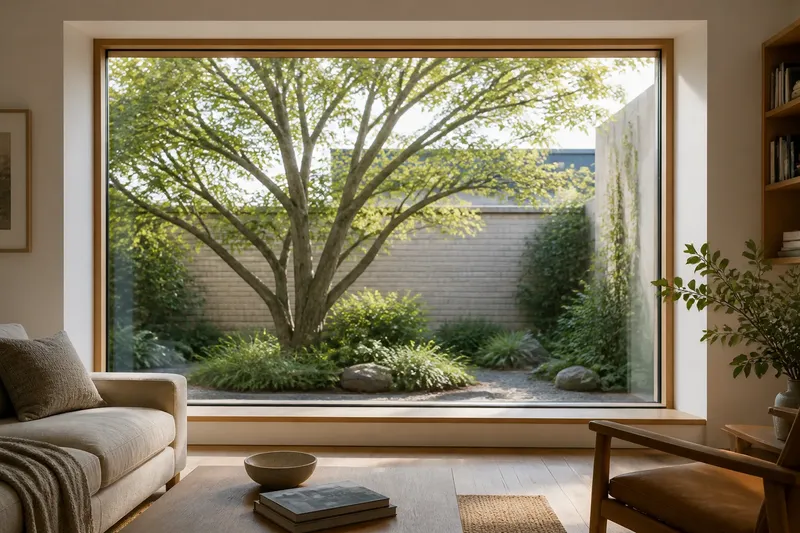
The common mistake in picture window design is treating the glass as a neutral hole in the wall. The cost is a view that can feel like a television screen, or a room exposed to glare and neighbouring windows. A picture window instead frames a particular slice of the outside world—and that slice changes with light, weather, leaves and movement.
A picture window frames a view, not just a wall
A picture window is a broad, generally fixed pane intended to frame a view rather than provide ventilation. The term describes its visual role, not one exact shape or construction method. It might be a single rectangle, a horizontal band, or a large fixed pane paired with narrower opening sections.
Because the central sash does not open, the view can remain relatively clear of meeting rails and operating hardware. But the glass is not literally frameless. The perimeter frame, wall thickness, sill and head all define the opening. Their proportions determine whether it reads as a calm border or a conspicuous sheet of glass.
A large window may chiefly admit daylight or connect a room to a balcony. A picture window makes the outward view part of the room’s composition. A stand of trees, a roofline or a small garden can become its subject.
How the picture window became a way to compose a room
Picture windows reflect several design interests: simpler architectural forms, changing possibilities in glassmaking and a desire to connect rooms with their surroundings. There is no single origin or invention to point to. The important shift was the choice to treat a selected exterior scene as part of an interior.
Older windows often divided glass into smaller lights with bars or muntins. Those divisions had practical and visual roles, and they made the window read as a repeated pattern. In some buildings, advances in glass production and construction made larger panes more feasible. As architects explored simpler surfaces and less applied ornament, broad areas of glass could suit that pared-back language. The timing and form varied by place and building type.
A window can draw the eye towards a garden, distant hills or a courtyard. The surrounding wall works like a mat around a picture: it gives the scene an edge and prevents the room from dissolving into a blur of exterior detail.
This is not tied to one façade style. In a house, the view might extend a sitting room towards a garden; in a civic interior, it might connect a public space with a square or planted court. The shared idea is selective framing.
The view changes as light, weather and seasons change
A picture window never presents exactly the same scene for long. Morning light may reveal detail beyond the glass, while a brighter sky can make reflections more prominent. After dark, a lit interior may appear more clearly in the pane than the street outside. Rain, cloud and moving shadows alter contrast, and wind can animate branches against a steady frame.
Season changes the view too. Bare branches may reveal a roofline in winter; summer leaves can screen a neighbour and cast moving shade. A passing person, a parked vehicle or new building work may briefly change what sits inside the frame. The window selects a scene, but it cannot freeze that scene in place.
These shifts are part of the design, not a flaw in it. A view that works only in one lighting condition may feel less settled than one with an appealing foreground, a clear point of focus and useful privacy across different conditions. Glass also reflects its surroundings, so the balance between seeing out and seeing a reflection changes with brightness and viewing angle.
How a framed view changes the room
A picture window gives the eye a destination. Furniture, circulation and wall space may organise themselves around it. A close, sheltered view can feel intimate; open land or a long urban vista can make the room feel more expansive.
That focus creates a hierarchy. A fireplace, bookcase or artwork may become secondary if the window dominates the wall. A low sill can keep a garden visible from a seated position. A higher opening may frame treetops or sky while preserving privacy at eye level. These are compositional choices, not simply questions of glass area.
Daylight and view are related but not interchangeable. A window can brighten a room while facing a blank wall, and a striking outlook can leave parts of the interior in shadow. Orientation, reveal depth and nearby surfaces influence how daylight enters and moves across the room.
Say you are arranging a sitting room that faces a small courtyard. The starting view has a mature tree near the centre and a neighbour’s wall beyond. You mark the usual seated sightline on a sketch, then compare possible opening positions: one centred on the tree, another shifted towards the wall. With the first position and a sill low enough to preserve the seated view, the expected result is that the tree anchors the composition while the wall remains at its edge. If the sill rises or the opening shifts, the tree may disappear from the seated view; the trade-off is a different frame, not automatically a better one.
How frame, sill and reveal shape what you see
The frame sets the boundary around the glass. A slender frame can make the view feel more continuous; a deeper or darker one can emphasise the act of looking through it. Neither is automatically better. The choice depends on the wall, interior and character of the building.
The reveal is the portion of wall between the outer face and the glass. A deep reveal can shade the pane and make the opening feel carved into the wall. A flush installation can make the façade look smoother, though the opening may seem to have less depth. The sill is both a ledge and a visual baseline: its height can hide a near view or bring the garden into the room.
Materials affect how the opening reads. Timber can bring warmth to the interior edge; painted metal can appear as a fine line; masonry can make the window feel embedded in a thick wall. Reflections also depend on the surroundings. At some angles, the pane may mirror the room or sky more strongly than it reveals the scene beyond.
Where ventilation is needed, opening sections can sit beside a fixed picture pane. Their frames and handles interrupt the view, so placement matters. A narrow casement at one side may leave a broad central composition intact; several opening lights across the pane may make the window read as a set of units.
What a picture window cannot do
A fixed picture window cannot open for fresh air. If a room needs ventilation through an opening, another suitable opening must be part of the design. A clear view can also reduce privacy, particularly after dark when a lit interior is more visible from outside.
Large areas of glass can bring practical trade-offs. Sunlight may cause glare or affect sensitive furnishings, and a cold surface can feel uncomfortable beside a seating area. The effects depend on orientation, shading, glazing and the rest of the building envelope. Blinds, curtains, external shading or carefully placed furniture may help, but each changes how much of the view remains visible.
Cleaning and maintenance matter as well. A high or awkwardly placed pane may be difficult to reach, and the frame must meet the wall in a way that manages water and weather. For product specifications or work affecting safety and the building envelope, follow the manufacturer’s instructions and consult an appropriately qualified professional.
What should you check in a picture window?
Stand where the room is actually used, rather than directly in front of the glass. Check the view from a chair, table or usual route through the space, then look at the opening from outside. The following observations can help you judge whether the window suits both the room and the wall.
- Check whether the main feature remains visible from the usual seating; if it does, the frame supports that view, but if it does not, compare the opening position or seating arrangement.
- Check whether the sill cuts off the near ground or garden; if it does, decide whether privacy is more useful, but if the view is needlessly blocked, review the sill height with the designer.
- Check whether the frame and reveal sit comfortably with the wall material; if they look strongly contrasted, decide whether that emphasis is intended, but if not, discuss a different finish or recess.
- Check where opening sections and handles interrupt the glass; if they cross the central view, consider moving them to one side, but if ventilation needs dictate their position, accept the visual division as a trade-off.
- Check for reflections and direct sun at different times of day; if they obscure the view or cause discomfort, consider shading or a changed seating position, but if neither occurs, preserve the open outlook.
- Check how the scene changes when leaves fall, lights come on or weather shifts; if privacy or the point of focus is lost, consider screening or a different frame, but if the view remains legible, keep the composition.
- Check whether the pane can be reached for cleaning and maintenance; if access is awkward, ask the designer or installer about a safe maintenance approach, but if it is accessible, confirm how the frame and surrounding wall are intended to be maintained.
What do readers ask about picture windows?
Does a picture window make a room feel bigger?
It can make a room feel more open by drawing the eye beyond the wall, especially when the view has depth. A close, blank surface offers less of that visual extension.
Is a picture window always one large pane?
No. It may use a fixed central pane with smaller opening sections or be divided into several fixed panes. Its defining feature is the deliberate role of the view, not a particular pane arrangement.
Why can a picture window look like a mirror?
Reflections become more noticeable when the exterior is darker than the room or the glass catches bright sky at an angle. As daylight and interior lighting change, the pane can shift between transparency and reflection.
Can a picture window work in a small room?
Yes, if its position and proportions suit the room and the view beyond. An oversized or poorly aligned pane may leave little useful wall for furniture and storage, while a carefully placed opening can give the room a visual destination.
Picture window design is an exercise in choosing what deserves attention from a particular place in a room. The main search phrase, picture window design, is useful to keep in mind when reading an elevation: look for the relationship between the opening, the wall and the view from inside. Then return at another time of day, if you can. The same frame may reveal a garden, mirror the sky or catch a moving branch, and each shift shows how the building meets its surroundings.