Why Some Doors Open into the Room
Why some doors open into the room becomes easier to read when you trace the hinge and swing arc, revealing how the entrance shares space with the room.
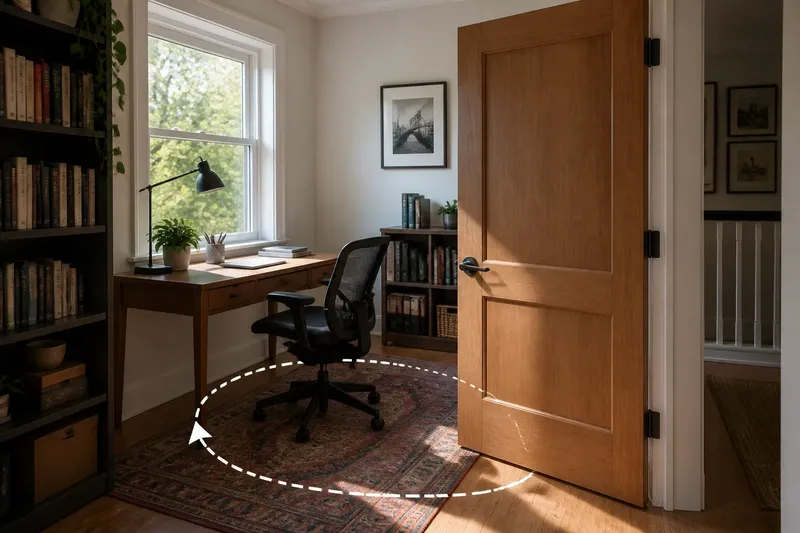
The common mistake is to judge a doorway by its open width alone. Why some doors open into the room becomes clearer when you trace the leaf’s path: it may leave a corridor unobstructed, but its swing can also cross a route or meet furniture inside.
Follow the hinges and imagine the door moving. The swing is a small, visible design choice: it connects the threshold to one part of the room while borrowing space from another. Like pulling out a chair at a table, opening a door needs more room than the object occupies when still.
Trace the hinge side and the swing arc
Stand where you can see the closed door without blocking anyone. Find the hinges: they mark the edge around which the leaf turns. The handle travels along the opposite edge, tracing a curve through the air. That curve is the swing arc, the area that needs to remain clear while the door moves.
Check which side of the opening the leaf occupies when open. An inward-opening door swings towards the room, but its hinge position and resting angle vary with the particular layout. It might sit near a side wall, reach across a corner or remain partly within a deep opening. The same room can feel different depending on where the leaf rests.
Look for a door stop, a fitting or surface that limits the door’s travel and helps prevent impact with a wall. Its location can indicate the intended resting point, though it does not reveal every reason behind the arrangement. A leaf that rests close to a wall may leave more of the doorway visually open; one resting at an angle may remain prominent.
Read the swing as a choice about arrival
An inward swing can keep the moving leaf out of a shared passage. It may also let someone enter and close the door without stepping back into the corridor. Whether that is useful depends on what lies inside the room and how people use the entrance.
The leaf also claims floor area while moving. It might cross a route to a desk, reach towards a wardrobe or cover a switch. The handle could meet a cupboard before the door reaches its stop. These are observable conflicts, not proof that the layout is wrong: the furniture may move, the door may not open fully in ordinary use, or another constraint may shape the arrangement.
Notice what the open door conceals. It might screen a coat hook or storage recess, block part of a view, or cover a stretch of wall. Such effects can be intentional or incidental. The visible arrangement tells you what the open leaf hides, not necessarily why anyone chose that position.
Compare inward and outward movement at the threshold
An outward-opening door shifts its arc to the other side of the opening. That can keep the leaf out of a tight room, but the movement then occupies a hall, landing or approach. In a busy corridor, it may interrupt someone passing; at an exterior entrance, steps or the usual path may affect how it can be used.
Neither direction is automatically better. Ask where the moving leaf can rest without obstructing a route, meeting another door or making it difficult to stand at the threshold. The answer depends on the particular layout and use. A bathroom, cupboard and main entrance can face different constraints even when their openings look similar.
Notice how someone approaches the handle. Its position, the hinge side and nearby walls all affect where a person can stand to open the door. Observe the actual movement where possible rather than assuming that one hinge arrangement always causes the same approach.
Record the door’s route with a simple sketch
Choose a familiar building and observe a doorway during ordinary use, without obstructing anyone or handling a door that is not yours to use. Note the hinge side, direction of travel, resting position and anything that appears to overlap the arc.
Draw the opening as a line, mark the hinge with a dot and add a curved arrow for the swing. Add nearby objects only when they affect movement, such as a chair, a second door or a narrow passage. Treat the sketch as a record of what you can see, not as a precise building plan.
Use these checks to separate an observed condition from a decision about what it means:
- Observe whether the open leaf crosses a route. If it does, note who needs that route and when; then compare the obstruction during ordinary use, or record that the conflict appears only during opening.
- Observe whether the leaf meets furniture before reaching its stop. If it does, note the contact point; then distinguish a clear collision from a door that simply rests close to the furniture.
- Observe whether the handle or leaf covers a switch. If it does, note whether the switch remains reachable with the door open; then record the access limit, or note that the control stays clear.
- Observe whether the door enters a corridor or landing when opened. If it does, watch whether people need to pass there; then record the shared-space conflict, or note that the arc falls outside the usual route.
- Observe whether another door’s path overlaps this one. If it does, watch the order in which people use them; then record the sequence that avoids contact, or note that no overlap appears in ordinary use.
- Observe where the leaf rests against a stop or wall. If it rests at an angle, record what it conceals; then note the blocked view or access, or record that the resting position leaves those areas visible.
Say you are sketching an invented study with a door, a desk and a chair on the route from the threshold to the desk. You mark the hinges, draw the door’s observed arc and mark the chair in the position shown on your sketch. The arc crosses the chair’s drawn position, so the sketch indicates that the door and chair cannot occupy that space at the same time. If the door reaches its stop only when the chair is moved, the resulting note is specific: the door opens fully after the chair is shifted. This establishes a spatial conflict in that imagined arrangement, not why it was chosen.
What can a door’s swing tell you?
Why might a bedroom door open inwards?
An inward swing can keep the leaf out of a corridor and let someone close the room off after entering. Check the hinges, stop and nearby furniture to see how that movement fits the particular room.
Can the open door show where its hinges are?
Often, the fixed edge is visible where the hinges attach, while the handle edge has travelled around it. If the hinges are obscured, a door stop or the hinge knuckles may help identify the fixed side.
Can a swing arc make a room feel smaller?
It can make floor near the entrance unavailable while the door is moving, especially if the leaf crosses a route or reaches towards a work area. The room itself has not changed size, but that part of it may be harder to use.
What should you note if the door meets another door?
Record where the two paths overlap and whether their leaves can move without contact. If use depends on opening one door first, note that sequence rather than assuming the overlap has only one explanation.
Separate visible clues from possible explanations
The hinges, stop, handle path and nearby clearances are visible clues. A reason for the arrangement is an inference. An inward swing might keep a corridor clear, suit the room’s furniture or reflect a constraint that is no longer apparent. The physical evidence shows what the door does, not what its designer intended.
Notice the depth around the opening as well. A deep jamb can leave part of the leaf within the opening when it is open, changing how much of the doorway remains clear. Door width alone does not tell you how the leaf meets the wall; hinge position and opening depth matter too.
Pay attention to how people use the threshold. Someone might hold the door for a person behind them, pause to let another person pass or leave it ajar. Each action changes where people stand and how the swing affects the room.
Revisit an awkward doorway before judging it
Return to one doorway that seemed awkward and observe it during another ordinary moment. Note whether the door is open, held or closed, and what is visible or accessible in each position. Do not interfere with anyone using it; a quiet observation from the edge of the route is enough.
Keep the note concrete: “the open leaf crosses the route to the desk” says more than “the layout is bad”. Why some doors open into the room is easier to read when you separate the arc you can see from the reasons you can only infer. That distinction helps you describe how an entrance shares space without mistaking a clue for a verdict.